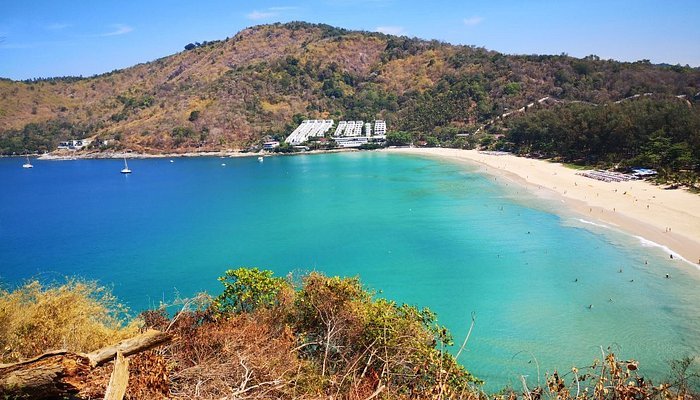
Start with the beach you want to use
Nai Harn makes a coherent focus for a southern Phuket beach day. Phuket’s provincial guide places it north of Promthep Cape and identifies a freshwater lagoon inland. Those two features help frame a visit: time on the shore, a look around the inland side, and a possible road outing to the cape. You do not need to turn them into an ambitious circuit to enjoy the area.
The first choice is whether Nai Harn is your main beach or a day trip from another part of Phuket. If you want to return to the same sand most mornings, the actual route between your accommodation and the beach deserves close attention. If you are visiting once, choose a clear drop-off point and a realistic return arrangement. A hotel address labelled Rawai does not, by itself, establish that Nai Harn is an easy walk from your room.
The sea can change the whole day
The provincial government specifically advises against swimming at Nai Harn from May to October because of strong currents. Treat that as a serious seasonal caution, while also following current flags, notices and lifeguard instructions whenever you visit. A date outside that period is not a guarantee of safe water. During the caution period, plan a shore visit and another activity so that swimming is not the condition on which the whole day depends.
Thailand’s Department of Marine and Coastal Resources explains that rip currents flow away from shore and can carry swimmers with them. Do not use sunshine, another person entering the sea or a hotel’s attractive photograph as your safety test. Stay out when local warnings prohibit swimming. With children, decide beforehand who is supervising at the waterline rather than assuming that everyone is watching. If the water does not look suitable, there is no need to search along the bay for a way around the warning.
Pack for a beach walk as well as a possible swim: drinking water, sun protection, a cover-up and a bag that keeps essentials dry. Keep passports and unnecessary valuables at your accommodation if appropriate. Agree a recognisable meeting place before people spread out, and leave enough energy for the walk back from the sand. A short visit that suits the conditions is more rewarding than staying until everyone is hot, tired and reluctant to move.
Choose a hotel for the journey it creates
The Nai Harn’s official website identifies its setting overlooking Nai Harn Bay. That is a different proposition from choosing a reviewed hotel elsewhere in Rawai and travelling to the beach. Compare the exact room position and route to the public shore rather than allowing a sea-view photograph to answer both questions. A view from a hillside room and the effort of returning from the beach are separate considerations.
Our Rawai and Nai Harn hotel reviews cover several different settings. Use them to identify the holiday routine that suits you: spending substantial time at the resort, returning regularly to this beach, or making separate road outings. Do not assume every Rawai property has a sandy swimming beach outside. Before booking, ask about steps, slopes and the route from the specific room category if mobility is a concern. This guide does not certify any hotel-to-beach route as step-free.
Pair Nai Harn with Promthep without rushing
Promthep Cape can fit naturally into a day focused on southern Phuket because the provincial guide places Nai Harn to its north. Plan it as a distinct road stop, with a pickup or parking arrangement, rather than assuming a continuous coastal beach walk. If the cape is the evening goal, decide where you will eat and how you will leave afterward before you spend the afternoon on the sand.
A flexible itinerary might start with Nai Harn, pause for lunch and a change of clothes, and continue to the cape if the weather and everyone’s energy suit the idea. You can also reverse priorities and keep the beach as the only stop. Sunset is a weather-dependent experience; do not build a fragile flight connection or a prepaid onward transfer around seeing a particular sky. If clouds or rain arrive, the day should still have a sensible end.
The inland side and the final checks
The lagoon noted by the provincial guide is a useful inland landmark when orienting yourself, not evidence of a supervised swimming alternative. Take a look from a suitable public place and follow any local notices. Avoid turning a beach outing into an unplanned search for water activities elsewhere simply because the sea is rough. Ask locally about the condition of the route before taking a longer walk in the heat or after rain.
No verified current admission charge, parking tariff or universal opening schedule was established for Nai Harn in the sources checked. That does not mean every service is free or restrictions cannot change. Read posted notices and agree the cost of any transport or paid service before using it. Give your driver the exact beach meeting point and keep the return details available offline. The practical aim is a day with fewer uncertainties: the right bay, a clear journey home and enough flexibility to accept the sea as it is.
A few useful answers
When does the provincial guide advise against swimming at Nai Harn?
Phuket’s provincial guide advises against swimming from May to October because of strong currents. Follow local warnings at all times; other months are not a guarantee of safe water.
Is every Rawai hotel a Nai Harn beach hotel?
No. Check the exact location and route to Nai Harn. The Nai Harn identifies its position overlooking the bay, while other Rawai properties can require a separate journey.