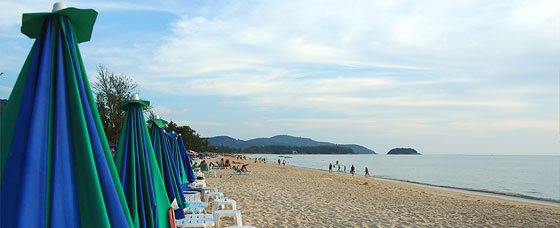
A beach that needs a location decision
Karon is a good place to start if your Phuket plans revolve around a long stretch of sand and a town with places to eat and shop. Phuket’s provincial tourism page places it north of Kata and describes restaurants, bars, shops and tour businesses nearby. The useful decision comes after that broad introduction: which part of the bay will you actually use each day? A beach name alone is too imprecise to settle a hotel booking.
Pick one public beach access as your reference point before comparing accommodation. Put the hotel entrance, that access and two plausible dinner stops on a map. Then look at the route between them. A property can be described as being in Karon while still creating a different routine from the one you pictured. If an easy return for a shower matters, judge the actual route with a wet beach bag, rather than only the distance shown beside a hotel listing.
Karon, Kata and the address trap
The Tourism Authority of Thailand describes Karon as lying north of Kata, with a low hill separating them. That makes the two beaches sensible alternatives for the same holiday, but it does not make them one continuous piece of sand. Choose Karon for the Karon beach day you want; choose Kata if most of your meals and beach time will happen there. You can visit the other bay without moving hotels.
Check hotel names and postal districts especially carefully. The Boathouse Phuket gives its location as Kata Beach; Katathani identifies its own setting as Kata Noi Bay. Both can appear in searches associated with Karon because Karon is also an administrative place name. Neither should be mistaken for a hotel on Karon Beach. In our reviewed selection, a Kata hotel can support a road excursion to Karon, but it should be booked with that journey in mind, rather than sold as a Karon beachfront stay.
For a family, the more useful comparison may be the number of separate journeys in a day. Write down breakfast, the beach, an afternoon break and dinner. If each one involves arranging transport, a cheaper room farther away may not simplify the trip. Conversely, someone spending most of the afternoon at the hotel may be comfortable making just one deliberate excursion to another bay.
Getting there and moving between bays
Karon is reached by road. The provincial guide describes approaches from the Kata side and from Patong; its published journey estimates should not be treated as a promise for your arrival. Give a driver your precise destination, preferably the agreed public access or hotel entrance, and keep the written address available. Ask whether the quote is for the vehicle or each passenger and whether any waiting or return journey is included.
Treat a Karon–Kata beach comparison as a small outing with a clear return plan. You might spend a morning on one beach, have lunch, and visit the other only if everyone still has energy. There is little benefit in moving bags between several bays just to collect photographs. If someone uses a walking aid or wheelchair, ask about the chosen access surface, kerbs, road crossing and distance over sand before setting off. This guide does not establish a continuously accessible route.
What to do when you reach the sand
Start with a short orientation walk rather than committing immediately to a full beach day. Look for the beach notices, the part of the shore being used by swimmers, and where you can buy water or find a suitable lunch stop. Take only the valuables you need. Choose a spot from which everyone in your group can easily recognise the way back to the agreed meeting point, especially if different people want to walk in different directions.
Decide about swimming from the local conditions and lifeguard advice that day. Thailand’s Department of Marine and Coastal Resources explains that rip currents can carry swimmers away from shore. A calm-looking patch of water should not be used as a reason to ignore warning flags. Stay out when red flags or local instructions prohibit swimming. If conditions are unsuitable, keep the visit as a beach walk and lunch outing; the day does not have to depend on entering the sea.
Build a day with room to change
A manageable plan is to arrive with time for a walk and a swim decision, have lunch without rushing, then choose between returning to your room or continuing to Kata. Save a separate afternoon for a viewpoint if that is important to you. TAT identifies the Three Bays viewpoint as overlooking Kata Noi, Kata and Karon, but a viewpoint visit needs its own road journey and should not be confused with an easy stroll along the beach.
No current beach opening schedule, parking tariff or blanket admission charge was established in the sources checked for this guide. That is not a claim that every service is free or that access can never be restricted. Check local notices, agree any paid beach services before using them and carry a little flexibility for weather. The best Karon plan is one that still works if the sea is unsuitable or your group decides that one bay is enough for the day.
A few useful answers
Are hotels with a Karon address always on Karon Beach?
No. Karon is also an administrative place name. The Boathouse Phuket is on Kata Beach, while Katathani identifies its setting as Kata Noi Bay. Check the exact hotel entrance and beach before booking.